How to Activate L-Cells: Your Natural GLP-1 Factories
Complete GLP-1 Knowledge Series:
→ Natural GLP-1 Activation | L-Cells | DPP-4 Enzyme
→ GLP-1 Signaling | Postprandial Glucose | Metabolic Flexibility
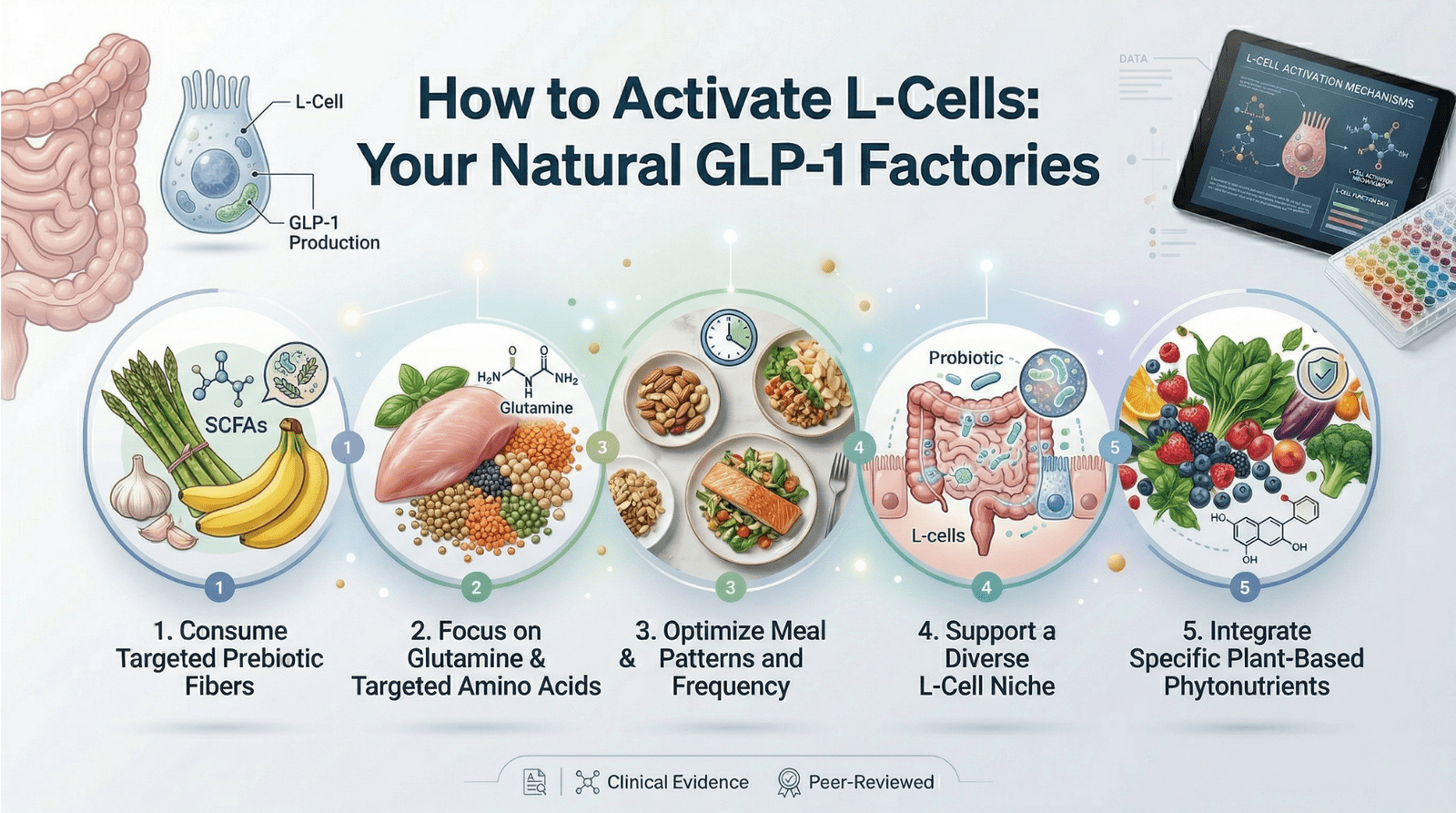
Your intestine contains specialized cells that function as natural hormone factories. These cells, called L-cells, produce GLP-1—the hormone responsible for appetite regulation, satiety signaling, and metabolic balance.
Understanding how to activate L-cells naturally represents one of the most powerful strategies for optimizing metabolic health. Unlike synthetic interventions that bypass your body’s natural systems, L-cell activation works with your innate physiology to support healthy GLP-1 production.
This article explores the science behind L-cell activation and provides evidence-based strategies to optimize these remarkable cells through diet, lifestyle, and targeted nutrients.
What Are L-Cells and Why Do They Matter?
L-cells are specialized enteroendocrine cells located primarily in the lower small intestine (ileum) and colon. They belong to a family of gut cells responsible for producing various hormones that regulate digestion, metabolism, and appetite.
The L-Cell Function
L-cells perform several critical metabolic functions:
- GLP-1 Production: Convert proglucagon (precursor protein) into active GLP-1 hormone
- Nutrient Sensing: Detect proteins, fats, and carbohydrates passing through the intestine
- Gut-Brain Communication: Release peptide YY (PYY) that signals satiety to the brain
- Metabolic Regulation: Respond to short-chain fatty acids produced by gut bacteria
Research demonstrates that L-cell density and function can be influenced by dietary patterns, gut microbiome composition, and specific nutrients. This means you can actively optimize your body’s natural GLP-1 production system through strategic lifestyle interventions.
The L-Cell Activation Pathway
Understanding how L-cells produce GLP-1 helps clarify why certain strategies work better than others.
The Proglucagon to GLP-1 Conversion
L-cells contain the gene GCG, which encodes proglucagon—the precursor molecule for GLP-1. The enzyme prohormone convertase (encoded by the PCSK1 gene) then cleaves proglucagon into several active peptides, including GLP-1.
When nutrients arrive in the lower intestine, L-cells activate this conversion process. The amount and type of GLP-1 produced depends on:
- The specific nutrients triggering L-cell receptors
- The health and density of L-cell populations
- The gut microbiome’s capacity to produce short-chain fatty acids
- The presence of factors that enhance or inhibit L-cell function
Key Insight: L-cells don’t just respond to food quantity—they respond to specific nutrient signals. This is why meal composition matters as much as meal size for GLP-1 production.
Strategy 1: Optimize Protein Timing and Quality
The Science: L-cells contain specialized amino acid sensors that detect protein in the intestinal lumen. When activated, these sensors trigger GLP-1 secretion. Research from Université de Louvain demonstrates that protein is one of the most potent natural L-cell activators (PMID: 33820962).
How It Works: Specific amino acids—particularly leucine, glutamine, and arginine—bind to G-protein coupled receptors on L-cells, initiating a cascade of cellular signals that result in proglucagon processing and GLP-1 release.
Practical Application
- Morning: 25-30 grams protein at breakfast (highest L-cell response)
- Midday: 20-25 grams protein at lunch
- Evening: 25-30 grams protein at dinner
- Complete proteins: Eggs, Greek yogurt, cottage cheese
- Leucine-rich sources: Chicken breast, turkey, whey protein
- Fish and seafood: Salmon, cod, shrimp (also provide omega-3s)
- Plant proteins: Lentils, chickpeas, quinoa (combined with fiber)
Strategic Timing: Consuming protein early in meals triggers L-cell activation before carbohydrates arrive, potentially enhancing the overall GLP-1 response and improving postprandial glucose regulation.
Strategy 2: Fermentable Fiber for SCFA Production
The Science: L-cells express receptors for short-chain fatty acids (SCFAs)—particularly butyrate and propionate. When gut bacteria ferment dietary fiber in the colon, they produce these SCFAs, which directly activate L-cells to secrete GLP-1.
How It Works: Fermentable fibers resist digestion in the small intestine and reach the colon intact. There, beneficial bacteria metabolize these fibers into SCFAs. These metabolic byproducts bind to GPR41 and GPR43 receptors on L-cells, triggering GLP-1 production.
Practical Application
- Resistant starch: Cooked and cooled potatoes, green bananas, oats
- Inulin-rich foods: Chicory root, Jerusalem artichokes, garlic, onions
- Beta-glucan: Oats, barley, mushrooms
- Pectin: Apples, pears, citrus fruits
- Psyllium husk: Supplemental fiber with strong L-cell activation
- Total fiber: 30-40 grams daily
- Fermentable fiber: 15-20 grams daily
- Gradual increase over 2-3 weeks to prevent digestive discomfort
Pro Tip: Combining different fiber types optimizes SCFA diversity. Each type of fermentable fiber produces different ratios of butyrate, propionate, and acetate—all of which activate L-cells through slightly different mechanisms.
Strategy 3: Support L-Cell Density Through Microbiome Health
The Science: The density and function of L-cells in your intestine isn’t fixed—it adapts based on your gut microbiome composition. Research demonstrates that beneficial bacteria, particularly Akkermansia muciniphila, directly influence L-cell proliferation and GLP-1 secretion capacity.
How It Works: Akkermansia and other beneficial bacteria produce metabolites that support intestinal barrier health and create an optimal environment for L-cell function. When the gut microbiome is balanced, L-cell density increases and their GLP-1 production capacity improves.
Practical Application
- Polyphenol-rich foods: Pomegranates, cranberries, blueberries, green tea
- Prebiotic fibers: Garlic, onions, leeks, asparagus
- Omega-3 sources: Fatty fish, walnuts, flaxseeds, chia seeds
- Fermented foods: Yogurt, kefir, sauerkraut, kimchi
- Avoid excessive antibiotics: When possible, preserve gut bacteria diversity
- Limit artificial sweeteners: May negatively impact beneficial bacteria
- Regular exercise: Supports beneficial bacterial populations
- Adequate sleep: 7-9 hours supports microbiome balance
Strategy 4: Fatty Acid Signaling for L-Cell Activation
The Science: L-cells express receptors that detect specific fatty acids in the intestinal lumen. Long-chain fatty acids, particularly omega-3s and monounsaturated fats, trigger L-cell activation through GPR120 and GPR40 receptors.
How It Works: When healthy fats reach the lower intestine, they bind to fatty acid receptors on L-cells. This binding triggers intracellular signaling cascades that result in proglucagon processing and GLP-1 secretion. The type of fat matters—omega-3 fatty acids show particularly strong L-cell activating effects.
Practical Application
- Omega-3 rich fish: Salmon, mackerel, sardines, anchovies
- Monounsaturated fats: Extra virgin olive oil, avocados, almonds
- Plant-based omega-3s: Flaxseeds, chia seeds, walnuts
- Medium-chain triglycerides: Coconut oil (moderate amounts)
- Include healthy fats in each meal (10-15 grams per meal)
- Pair fats with protein and fiber for sustained L-cell activation
- Avoid excessive saturated fat which may impair L-cell function
Strategy 5: Meal Composition and Sequencing
The Science: L-cells don’t just respond to individual nutrients—they respond to the pattern, sequence, and combination in which nutrients arrive. Research demonstrates that meal composition and the order of macronutrient consumption significantly influence L-cell activation patterns.
How It Works: L-cells integrate signals from multiple nutrient sensors simultaneously. When protein, fiber, and healthy fats arrive together in specific ratios, they create a synergistic activation effect stronger than any single nutrient alone.
Practical Application
- Start with protein and vegetables: Activates L-cells early, triggers initial GLP-1 release
- Add healthy fats: Sustains L-cell activation, slows gastric emptying
- Include complex carbohydrates: Provides sustained nutrient flow to L-cells
- Finish with fruit (optional): Final fiber and polyphenol boost
- Protein source: 25-30 grams (palm-sized portion)
- Non-starchy vegetables: 2-3 cups (fiber and volume)
- Healthy fat: 1-2 tablespoons olive oil or ¼ avocado
- Complex carbohydrate: ½-1 cup quinoa, sweet potato, or legumes
Example L-Cell Optimizing Meals:
Breakfast: Greek yogurt with berries, ground flaxseed, chopped walnuts, and a drizzle of honey
Lunch: Grilled chicken over mixed greens with chickpeas, avocado, and olive oil dressing
Dinner: Baked salmon with roasted Brussels sprouts and quinoa, side of sauerkraut
Advanced Strategy: Time-Restricted Feeding
The Science: L-cells demonstrate circadian rhythms in their GLP-1 secretion capacity. Research suggests that L-cells are most responsive to nutrients during specific time windows, and that extended fasting periods may enhance L-cell sensitivity.
How It Works: During fasting periods, L-cells undergo a metabolic “reset” that may enhance their nutrient sensing capacity. When food is reintroduced after a fast, L-cells demonstrate heightened responsiveness to protein and fiber.
Practical Application
- 12-14 hour overnight fast: Eat between 8am-6pm or 9am-7pm
- First meal should be protein-rich: Maximizes L-cell response after fasting
- Last meal 2-3 hours before bed: Supports overnight metabolic processes
- Maintain consistency: L-cells adapt to regular feeding patterns
Important: Time-restricted eating isn’t appropriate for everyone. Consult with a healthcare provider if you have diabetes, eating disorders, or are pregnant/breastfeeding.
What to Expect: Timeline for L-Cell Optimization
L-cell activation doesn’t happen overnight—it’s a gradual adaptation process:
Week 1-2: Initial protein and fiber changes increase GLP-1 secretion per meal. You may notice improved satiety immediately after eating.
Weeks 3-4: Gut microbiome begins shifting toward beneficial SCFA-producing bacteria. L-cell sensitivity to nutrients improves.
Weeks 5-8: L-cell density may increase in response to consistent fiber and protein intake. Satiety signals become more pronounced.
Weeks 9-12: Full adaptation of L-cell populations and gut microbiome. Enhanced metabolic flexibility and natural appetite regulation.
3+ Months: Sustained improvements in L-cell function become the new baseline. Natural GLP-1 production optimized.
Important Considerations
Individual Variation: L-cell density and function vary significantly between individuals based on genetics, age, gut health history, and metabolic status. Some people respond more dramatically to these interventions than others.
Medical Conditions: If you have inflammatory bowel disease, celiac disease, or other gut disorders, consult a healthcare provider before making significant dietary changes. These conditions may affect L-cell populations and function.
Medication Interactions: If you take medications for diabetes or blood sugar regulation, consult your physician before implementing these strategies, as enhanced L-cell activation may affect your medication needs.
The Bottom Line
L-cells represent your body’s natural GLP-1 production system. Unlike synthetic interventions, activating L-cells through diet and lifestyle works with your innate physiology to support healthy metabolic function.
Research from Université de Louvain and other institutions demonstrates that strategic use of protein, fermentable fiber, beneficial fats, and meal timing can significantly enhance L-cell activation and GLP-1 secretion (PMID: 33820962).
The key is consistency. L-cell populations adapt over weeks and months, not days. By maintaining protein-rich meals, adequate fermentable fiber, microbiome-supporting foods, and strategic meal composition, you create an environment where L-cells can function optimally.
This isn’t about restriction or deprivation—it’s about understanding how your intestinal hormone factories work and providing them with the signals they need to support your metabolic health naturally.
Explore the Complete GLP-1 Series:
→ Natural GLP-1 Activation | L-Cells | DPP-4 Enzyme
→ GLP-1 Signaling | Postprandial Glucose | Metabolic Flexibility
Research Citations:
- PMID: 33820962 (Université de Louvain – Akkermansia & GLP-1)
* Disclaimer: These statements have not been evaluated by the Food and Drug Administration. The information provided is not intended to diagnose, treat, cure, or prevent any disease.
* Medical Disclaimer: The content on Nukleo.bio is for informational purposes only and is not intended as medical advice, diagnosis, or treatment. Always consult with a qualified healthcare provider before making changes to your diet or health regimen.